
Rising from the Ash: The Resilience of Australia’s Oldest Chinese Temple
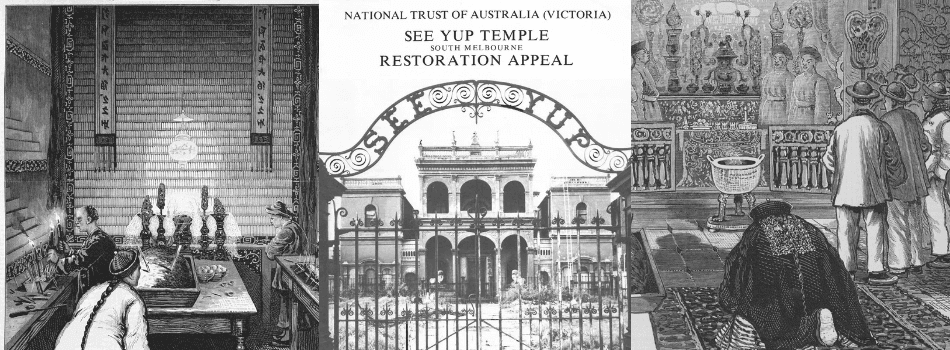
For over 170 years, the See Yup Temple in South Melbourne has stood as a silent witness to the evolution of Victoria. Founded by the oldest Chinese community organisation in Australia (originally to support people from the See Yup region in Guangdong Province), this site has seen continuous worship of Kwan Tai since 1856. It is a rare architectural gem, blending Chinese and Western designs, and is recognised as a site of heritage significance to the State of Victoria.
On the evening of 17 February 2024, that history was nearly lost. An electrical fault sparked a major fire in the 1866 Kwan Tai main hall. The devastation was profound: the “Heavenly Well” (the central skylight) was destroyed, and the timber ceiling, carved screens, and tiled floors were left scarred. But as the smoke cleared, a story of incredible community resilience began to emerge.
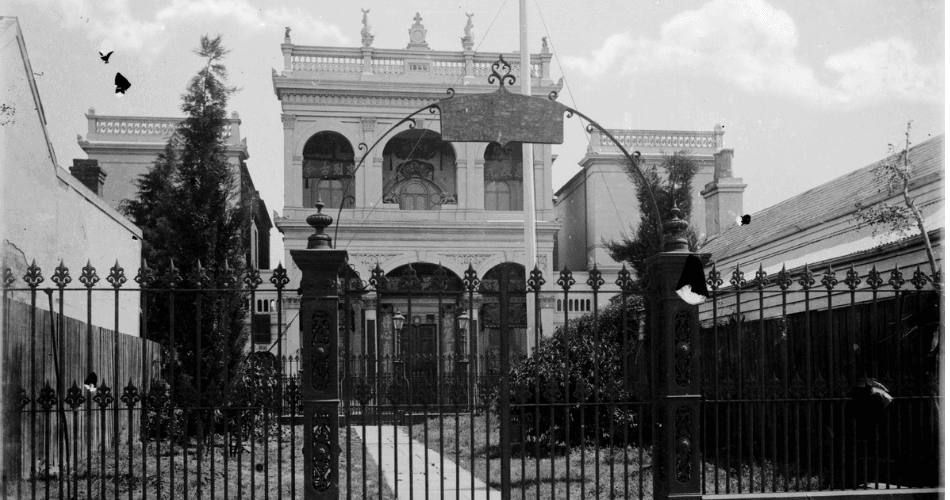
See Yup temple, photographed by John William Lindt, 1880s. Land for the temple was purchased progressively by the See Yup Society, Courtesy State Library of Victoria
The Night the History Smouldered
The fire was a heartbreak for worshippers and neighbours alike. One local resident left a single red rose at the gate, a small gesture for a community that felt a devastating loss. Inside the hall, over 200 objects – some nearly two centuries old – were damaged.
Yet, amidst the debris, there was a glimmer of hope: none of the Gods in the Hall were badly damaged. It was a small but powerful miracle for those who see the temple not just as a building, but as a living, spiritual home.
The Great Salvage: Precision and Patience
The immediate aftermath required a massive effort. The See Yup Society worked alongside structural engineers and Heritage Victoria to secure the site. The salvage process was as much an archaeological dig as it was a clean up:
- The Crane and the Well: A crane was brought in to remove the charred remains of the Heavenly Well so a temporary roof could be installed.
- Sifting for Fragments: Volunteers and professionals literally sifted through debris to recover tiny fragments of carved timber and building fabric.
- The First Inventory: Remarkably, no comprehensive list of the temple’s objects existed before the fire. An inventory was quickly created, documenting the “before and after” state of every recovered item for future restoration.
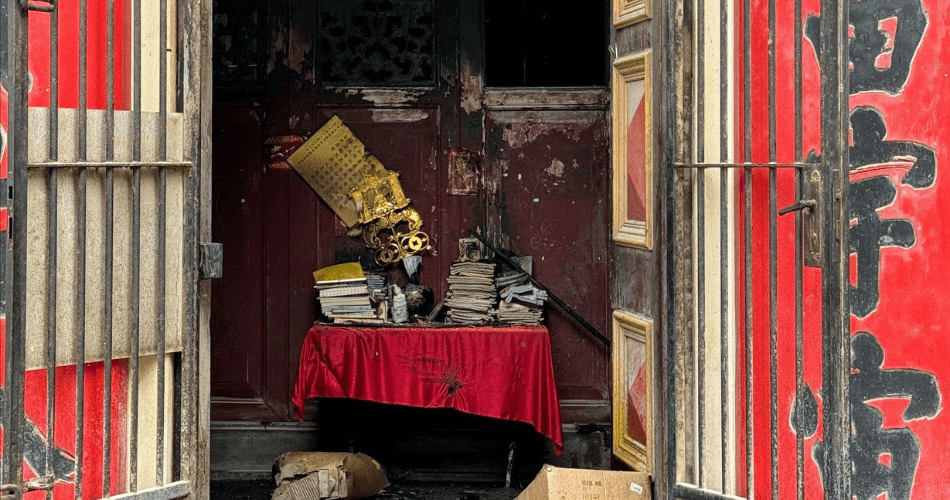
Morning after the fire, Courtesy S. Couchman
Keeping the Faith: The Garden Temple
The See Yup Society faced a difficult choice: keep the temple closed for years of repairs or find a way to let the community back in. They chose the latter. By 1 January 2025, the temple partially reopened for Lunar New Year with a temporary garden temple.
This “pop-up” sanctuary, consisting of marquees and a specialised “pod” to house Kwan Tai, allowed worship to continue while heavy recovery work proceeded on the main buildings. It was a testament to the fact that while the halls were damaged, the spirit of the community remained intact.
The Science of Saving History
The restoration of the temple’s artifacts is a slow, meticulous process. Of the objects recovered, 176 require specialist treatment. Many items contain toxic materials that must be handled with expert care.
- The Immortal Horses: Two of the temple’s most beloved objects: a German rocking horse and a probable American carousel horse, have been in the temple since at least 1899. They are currently being stabilised by specialist conservators.
- Laser Technology: Conservators are even using laser cleaning tests to determine how to best remove soot from highly gilded donation plaques without damaging the gold leaf beneath.
- A Rediscovered Treasure: In a surprising twist, a painted scroll of Kwan Tai was “rediscovered” after the fire. This fragile piece may date back to the original 1856 timber temple.
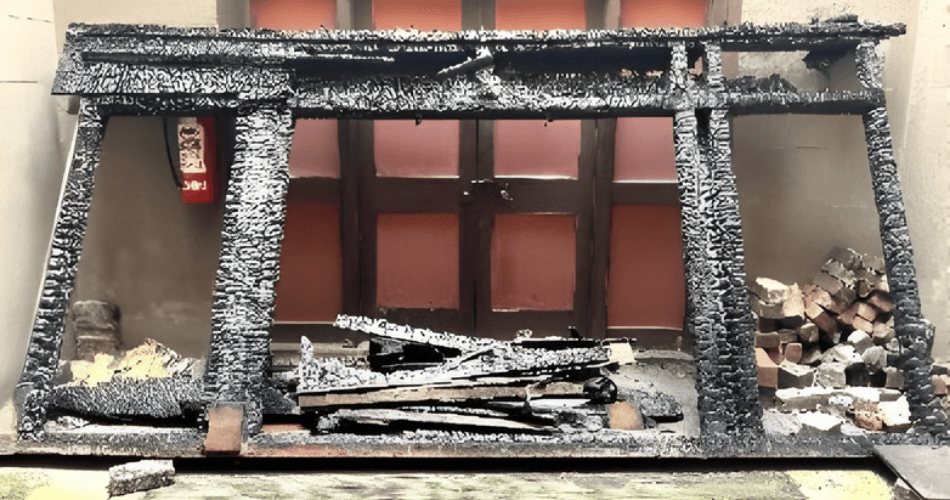
A crane was required to remove the burnt remains of the Heavenly Well Skylight, Courtesy J Beeston
The Road to Recovery: A $5 Million Challenge
The “Stage 1 Scoping Report,” prepared by Frontier Heritage Pty Ltd, has finally laid out the scale of the task ahead. The list of essential works is staggering: reconstruction of the Heavenly Well, conservation of the tiled floors, columns, doors and windows and a complete overhaul of the electrical and fire systems is just the start.
The financial reality is sobering. Returning the Kwan Tai Hall to its pre-fire condition is estimated to cost more than $5 million – and that’s just for the building, not the contents. While insurance will help, the See Yup Society is likely “significantly under-insured” for a project of this complexity.
How CHIN helped with Chinese translation
Many organisations, like CHIN Communications, have donated resources and time.
Launched on 21 February 2026, the See Yup Temple Recovery project has put together an exhibition mapping out the history, the fire and the road forward. To be accessible to the Chinese community and as a record of the event, CHIN undertook translation of the exhibition panels in Traditional Chinese. We hope that this will encourage others to join the effort.
How You Can Help
The See Yup Temple has survived lean years and the “White Australia” policy through the sheer will of its supporters. Now, it needs that support again. The society is calling on the public to help “Bring Kwan Tai Home” through:
- Tax-Deductible Donations: Managed through the National Trust of Australia (Victoria).
- Spreading the Word: Following their new social media presence on Facebook and Instagram.
- In-Kind Support: Volunteering for cleaning and maintenance tasks.
As recovery works move into the documentation and tendering phases, expected to be completed in mid-2026, every bit of support helps ensure that “Victoria’s Hidden Treasure” survives for another 170 years.
